Long-term investment focus
Superior revenue growth, profitability and cash flow generation, together with greater focus on and investment in research and development.
A unique
investment philosophy.
Our investment universe consists of publicly traded, family-controlled holding companies with portfolios of high-quality listed and/or unlisted companies, a strong track record of capital allocation, trading at a discount to fair value and with solid balance sheets.
Long-term equity investment is a differentiating factor in compounding capital.
We view equities as the most attractive real asset in terms of long-term profitability, and real assets as a means of protecting value against inflation.
It is important to stay invested and compound value over the long term. Compound capitalisation generates returns on previous returns, with much of the resulting wealth creation occurring in the later years of an investment.
Stay invested for the long term and allow capital to compound.
Our investment case for publicly traded, family-controlled companies rests on their record of long-term performance, supported by a long-term investment focus, greater risk aversion and a heritage dimension.
Superior revenue growth, profitability and cash flow generation, together with greater focus on and investment in research and development.
Frugality, greater prudence in decision-making and risk aversion, supported by lower levels of financial leverage.
Greater social responsibility towards employees, customers, suppliers and other stakeholders, more effective governance and talent retention.
Their name is often on the door.
Investment characteristics to consider within the universe of publicly traded, family-controlled companies.
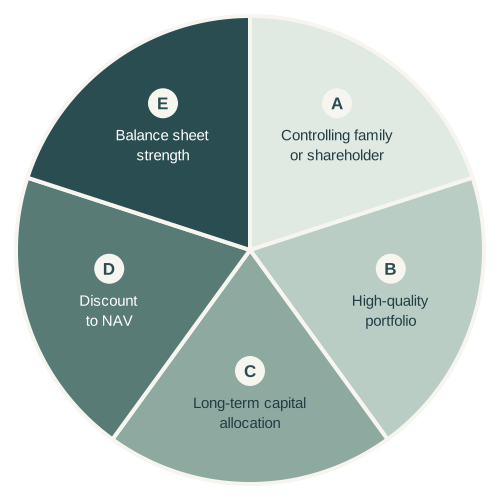
Presence of a controlling family or shareholder with a long-term vocation and strategic vision.
A high-quality portfolio of listed and/or unlisted companies with the potential for sustained, above-average, long-term growth.
A strong track record of capital allocation with returns in excess of broader equity markets.
Investment in companies trading at a discount to their net asset value, preferably with a catalyst to reduce the discount.
A solid balance sheet with limited financial indebtedness.
Our competitive advantage is supported by general misconceptions about family-controlled holding companies. Holding company structures attract inefficiencies and misconceptions that can create investment opportunities.
Family involvement is fundamentally under-appreciated despite a record of value creation and outperformance.
The high quality of listed and unlisted assets can be missed because of holding company structures.
Investors often prefer to diversify assets directly rather than through holding companies.
Family-controlled holding companies are under-researched, overlooked and inefficiently priced.
The combination of a portfolio of high-quality companies managed by long-term capital allocators creates the potential for superior asset value growth. Investing in companies that trade at a discount to net asset value provides an additional potential source of return.
Neither is guaranteed. Discounts can persist or widen.
An additional characteristic of this investment universe is that it mainly comprises serial-acquirer holding companies with portfolios of unrelated businesses. These models differ in their degree of operational integration.
Non-differentiated products, with scale-driven synergy targets.
Product differentiation, subsidiary clustering and shared operational excellence programmes.
Product differentiation, little to no integration and shared operational excellence programmes.
A diversified business portfolio, with influence through board representation.

Explore our investment strategy, holding company universe and approach to permanent capital.
Open presentation Read on this website →